



Key Points
- Governments publicly champion worker safety — yet rarely evaluate a bidder’s safety program when procuring security services.
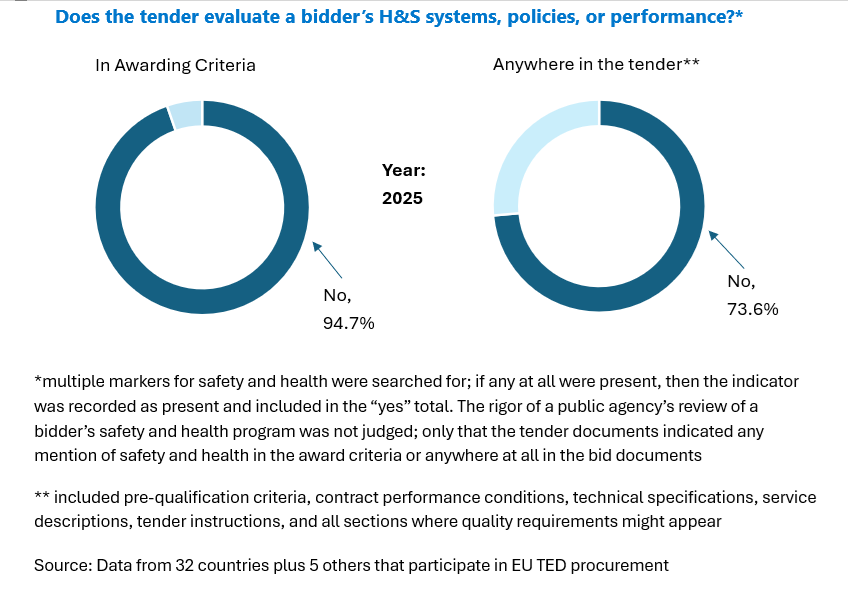
- New GSB Pulse data shows that only 1-in-4 tenders mention health and safety at all, and just 5.3% include it in award criteria.
- By integrating safety considerations into procurement, public authorities can reduce injuries, strengthen professionalism, and better protect frontline officers.
Governments around the world routinely affirm that protecting workers is a core public responsibility. The European Commission states plainly that occupational safety and health is a fundamental element of the EU’s social policy and that authorities must ensure high levels of protection for workers across all sectors. (Health and Safety at Work, European Commission).
Likewise, the UK’s Health and Safety Executive insists safety is fundamental, noting that “people have a right to return home fromwork safe and sound,” underscoring the state’s duty to promote safeworking environments (Health and Safety Executive).
Yet, despite these strong, unambiguous commitments, when governments purchase security services — a sector where frontline personnel face elevated and well‑documented risks — their procurement practices rarely reflect the safety priorities they publicly champion.
Do Public Authorities Make Health & Safety Considerations When Contracting for Security Services?
Drawing on nearly 40,000 tender records, The International Security Ligue’s new GSB Pulse: Public Procurement of Security Services (Europe) reveals a striking disconnect between government rhetoric and government action, with the gap between values and practice particularly visible in the treatment of health and safety.
Security officers work in environments where risk is inherent — from managing public interactions to responding to emergencies, to operating in dynamic work environments. Injury rates in the security sector are consistently higher than the workforce average, and the severity of injuries is often greater.
Given these realities, one might expect public authorities to rigorously evaluate a bidder’s safety program before awarding a contract — but the reality is something else altogether.
When it comes to actions government could take to enhance worker safety, like including a review of a firm’s health and safety track record when putting out a bid for a security services contract, they usually don’t — missing an opportunity to reward companies that take health and safety seriously and raise the level of safety training in the industry.
In 2025, only 1-in-4 tenders made any mention of a bidder’s safety and health program or track record. This means that in the vast majority of contract notices, not a single marker of health and safety appeared anywhere — not even a single mention in a technical specification.
- Just 5.3% included any aspect of health and safety in the award criteria — the part of the tender that actually influences who wins.
- Fewer than 8% made any reference at all to fatigue management, such as requirements for rest breaks or limiting shift length.
- Less than 1% addressed mental health, stress management, or incident debriefing.
- “Safety policies” appeared somewhere in only 8.3% of tenders.
This means that three quarters of public buyers fail to ask basic questions about whether a prospective security provider:
- has a safety management plan,
- investigates incidents,
- has transparent reporting systems,
- holds ISO 45001 or equivalent certification,
- maintains sufficient safety governance, or
- has a strong safety performance history.
In other words, governments are not using procurement — one of their most powerful levers — to reward companies that take safety seriously.
Failing to consider health and safety in procurement exposes public authorities to preventable accidents, liability claims, operational disruptions, and reputational risk. More importantly, it exposes frontline officers to avoidable harm.
A provider with weak safety practices may overlook hazards, fail to investigate incidents, or neglect proper training. Conversely, companies with strong safety governance demonstrate proactive risk management, continuous improvement, and a commitment to officer wellbeing.
Governments — and all organizations that contract for security services — should take efforts to distinguish between these two types of providers.
How Can Public Authorities ‘Walk the Talk’ When Buying Security Services?
Governments can play an important part in reducing injuries to personnel in the global security services industry. Primarily, by reviewing a prospective security company’s safety program before hiring them and refusing to select a security company that is unable to demonstrate a strong safety record and a commitment to reducing injuries.
Compliance with local laws and regulations is merely one element in a sufficient review of a bidders’ safety and health program. Other indicators might include certification to international standards and globally recognized management systems, such as OHSAS certification, as it provides a measure of assurance that a provider has the structure necessary to address occupational health and safety and accident prevention.
Reviewing a provider’s safety program before awarding a contract can help raise industry standards, reduce injuries, and ensure that public funds support companies that prioritize worker safety.
Conclusion. Governments consistently affirm the importance of worker safety. Yet when purchasing security services — a sector where safety risks are acute — they rarely evaluate the very factors that determine whether officers have the training and support necessary to be protected on the job.
By integrating health and safety considerations into procurement decisions, both public authorities and frontline workers benefit, resulting in:
- improved service quality;
- fewer safety incidents;
- greater industry professionalism;
- better protection of frontline officers; and
- and better value for taxpayers.