



Key Points
- Competition is an essential ingredient of a healthy public procurement market.
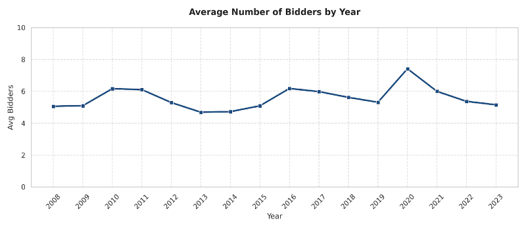
- In security services, the level of competition in Europe has remained fairly steady in the public procurement market, with the average number of bids today nearly identical to 2008 (5.2 vs. 5.1).
- Public authorities attract more bids to guarding services tenders when they use a multi-criteria approach to award decisions than when relaying on price alone.
Competition is the cornerstone of a healthy public procurement system, and nowhere is this more consequential than in the purchasing of security services. In the latest issue of GSB Pulse, the International Security Ligue examined tens of thousands of guarding service tenders across Europe and found a clear pattern: competition strengthens when public authorities look beyond price alone. Where multi-criteria approaches are used, more suppliers participate — the foundation to a more open and resilient procurement market.
Is competition important in public procurement of security services?
Competition is fundamental to effective public procurement, explains the Organisation for Economic Co-operation and Development (OECD). “In public procurement, competition promotes efficiency, helping to ensure that goods and services offered to public entities more closely match their preferences, producing benefits such as lower prices, improved quality, increased innovation, higher productivity and, more generally, ‘value for money’ to the benefit of end consumers, users of public services, and taxpayers,” notes the organization, a forum for best practices in public policy. (Competition in Public Procurement Markets, OECD, June 2017.)
Just how much value can be gained was recently the subject of a UK House of Commons Committee report. The auditing exercise assigned specific value to greater competition, noting that the government could achieve savings of £4 billion to £7.7 billion per year through increased competition. “Competition can help support efficiency, innovation, and quality in public services, by allowing buyers to select the bid that can supply the optimal balance of benefits and cost.” Additionally, beyond monetary savings and other direct benefits, greater competition in public service contracts acts to inspire confidence in public spending, the report notes. (Lessons learned: competition in public procurement, House of Commons Committee report, Committee of Public Accounts, Sixth Report of Session 2023–24, 13 December 2023.)
Competition can help support efficiency, innovation, and quality in public services, by allowing buyers to select the bid that can supply the optimal balance of benefits and cost.
How can “healthy competition” be measured in public procurement?
While competition can be measured in multiple ways, one widely accepted method is to examine how many suppliers choose to bid. As authors of a recent marketplace study note, “the intensity of competition is typically measured according to the number of bidders on any given public procurement market” (Intensifying Competition in Public Procurement, Public Organization Review, August 2023).
This aligns with the European Commission’s own approach: the Single Market Scoreboard treats bid counts — and especially the prevalence of single bid procedures — as a core indicator of competitive health in public procurement. In other words, when more firms are willing to compete, it is a strong signal that suppliers see the process as fair, accessible, and worth investing in.
How much competition is there in public tenders for guarding services in Europe?
The Ligue’s analysis of publicly available data from TED (Tenders Electronic Daily) includes a historical look at public contracting for guarding services in Europe, examining data from 2008-2023.
Analysis reveals that the average number of bids per security guarding contract has been steady — fluctuating in a narrow range between a high of 7.4 in 2020 and a low of 4.7 in 2013. The average number of bids per contract in 2023 was 5.15, nearly identical to 2008 levels (5.06).
The value of the contract appears to modestly increase the number of bids, with a more substantial increase for very large contracts. For the entire study period (2008-2023):
- Less than €250,000: Average of 5.2 bids;
- €250k to €1M: Average of 5.4 bids;
- €1M to €5M: Average of 5.6 bids; and
- More than €5M: Average of 8.3 bids.
How does awarding criteria impact the amount of competition in security contracts?
The Ligue’s analysis found an intriguing connection between award criteria and supplier participation. Public authorities that use multi‑criteria evaluation — rather than relying on price alone — consistently attract more bidders.
When public authorities use multi-criteria evaluation — rather than relying on price alone — they consistently attract more bidders.
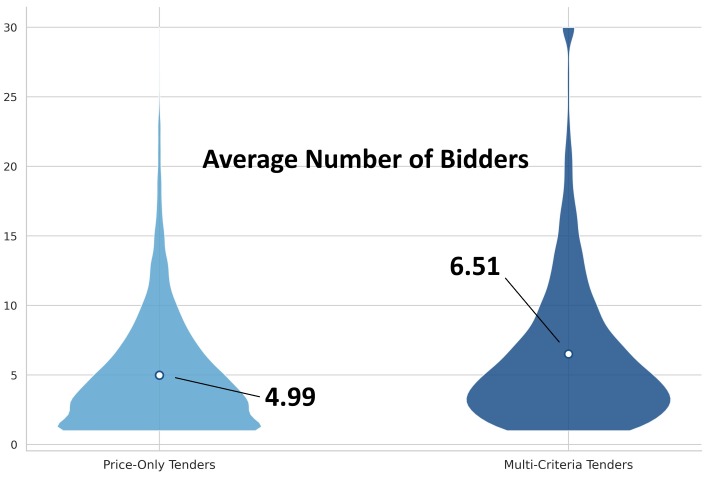
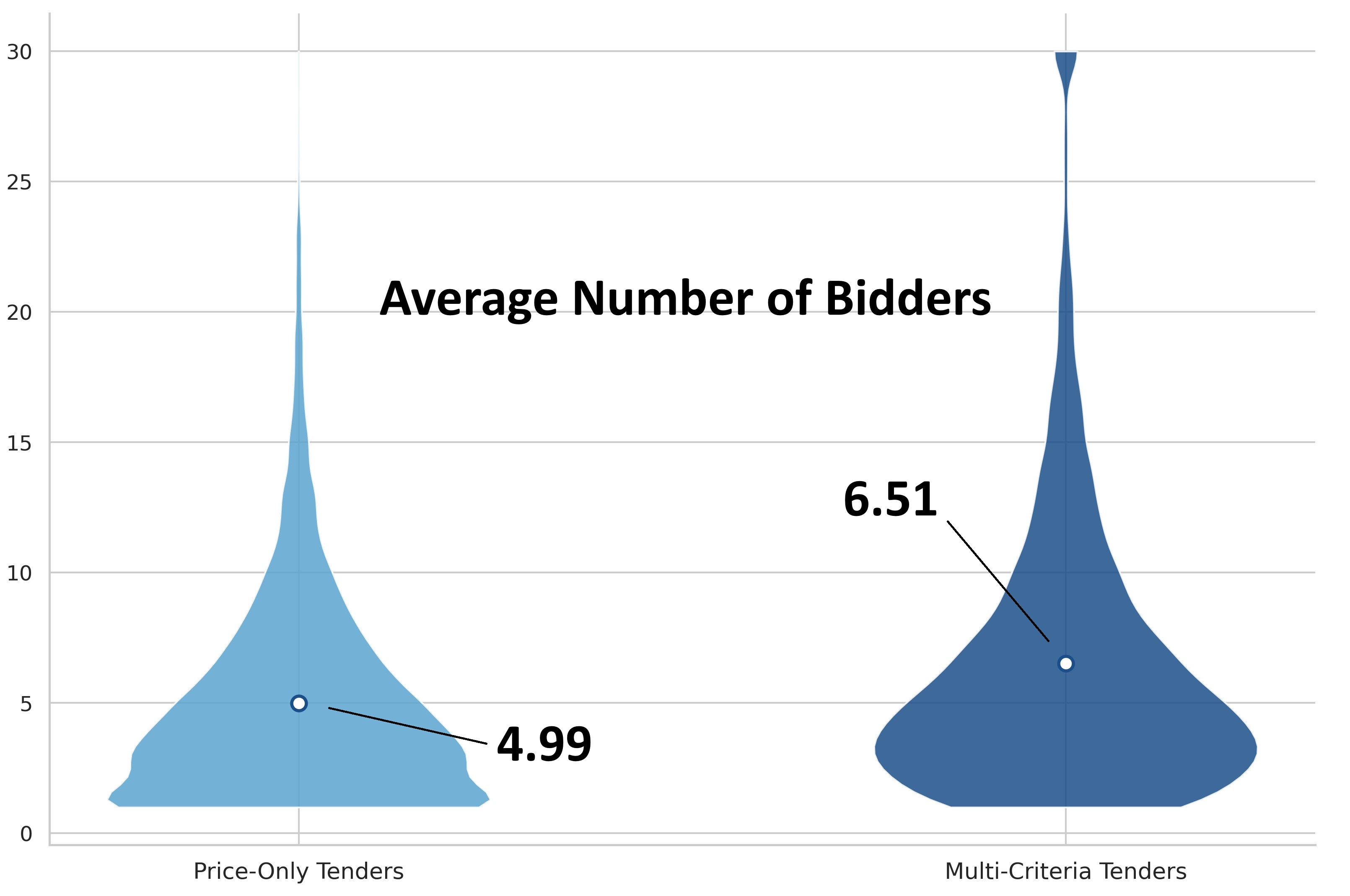
In our large sample of European guarding tenders, multi-criteria procedures received an average of 6.51 bids, compared with 4.99 bids for price-only awards. This suggests that when contracting authorities signal that quality, professionalism, and service standards will meaningfully influence the outcome, more suppliers are willing to invest the time and resources to compete. In other words, a quality-based approach is not only better aligned with the nature of guarding services; it also broadens competition and strengthens the overall procurement process. Additionally, Small and medium enterprises (SMEs) participate at the same rate in both types of procurement (with a similar win rate).
Transparency and clarity are important caveats, however. If contracting authorities fail to be explicit about how awards will be judged, the use of non-price criteria can potentially reduce the confidence of bidders in contracting authorities.
Does a more inclusive approach to awarding criteria help to attract more bidders? Yes. By 26.4%
Which is why — to achieve both better results and better value — governments should pair a quality-based approach to contract awards with greater transparency and engagement with business associations that have domain knowledge, explains Gavin Hayman, Executive Director at Open Contracting Partnership, a nonprofit organization that works globally with governments, businesses, and civil society to make public procurement fairer, more efficient, and more sustainable.
“It is not about buying cheapest but buying best. This can be particularly important in security procurement: cost-cutting undermines quality and leaves critical infrastructure vulnerable,” Hayman writes in GSB Pulse. “We need fair, competitive and open competition to drive innovation and value. If government goes out, engages businesses, listens to their ideas on how to deliver more impact before a competition is finalised, then we see more trust, and that leads to bids and competition.“
More information. These findings represent only a portion of the insights contained in the latest GSB Pulse. The full report is available for download and stakeholders are encouraged to distribute it widely. Get it here.