




Key Points
- Single- and no-bid contracts are clear indicators of weakened competition, often driven by unrealistic timelines and price-only evaluation.
- Limited competition not only reduces quality and value for public buyers but also increase the risk of favoritism, procurement irregularities, and undetected conflicts of interest.
- GSB Pulse data shows that quality-based award criteria and fairer tender design can meaningfully improve participation and strengthen procurement outcomes across Europe.
With competition at the heart of a healthy public procurement system, it is troubling that landmark European Court of Auditors report revealed that competition for public contracts in the EU decreased between 2011 and 2021, according to Gavin Hayman, Executive Director at Open Contracting Partnership, which works globally to make public procurement more efficient. “We need fair, competitive, and open competition to drive innovation and value,” he writes in the latest GSB Pulse, Public Procurement of Security Services (Europe).
It’s as true in security services as for any industry. When multiple qualified security providers compete for a contract, public authorities gain access to better solutions, stronger operational standards, and more professional guarding services. Competition pushes firms to innovate, to invest in training and supervision, and to demonstrate the real value they bring to public safety. It is one of the most reliable mechanisms governments have to ensure they are purchasing not just the lowest price, but the best service.
That is why single-bid and no-bid contracts matter. Rather than administrative anomalies, they’re indicators of a market failing to function properly. When a tender attracts limited bids, it signals that providers see barriers, distortions, or disincentives that keep them from participating.
“A lack of transparency about potential government contracting opportunities and lots of red tape leads to low or no bids,” explains Hayman. “And when governments fail to plan properly and issue emergency awards or approach their own favoured cronies, they undermine incentives to perform or compete.”
Single- or no-bid contracts don't prove wrongdoing, but they do create conditions in which fraud, collusion, or undue influence are more likely to go undetected.
While most single- or no-bid outcomes stem from weak competition or poorly designed tenders, they can also be early warning signs of more serious procurement risks. When only one firm participates — or none at all — it becomes harder for public authorities to demonstrate that the contract was awarded fairly, transparently, and at a price that reflects market conditions. In some cases, persistent single-bid patterns have been associated with vulnerabilities such as favoritism toward incumbents, restrictive specifications that benefit a single provider, or insufficient market outreach. These situations do not prove wrongdoing, but they do create conditions in which fraud, collusion, or undue influence are more likely to go undetected. For this reason, procurement systems around the world treat single- and no-bid contracts as important red flags that warrant closer scrutiny.
Sometimes tenders are designed in a way that unintentionally excludes capable firms, such as price-only evaluation that drives away top-quality providers who cannot compete in a race to the bottom. Regardless of the cause, the result is that public authorities lose the benefits of competition, and the quality of security services suffers.
Inside the Data
The International Security Ligue's latest GSB Pulse shows that these patterns are not rare. Across Europe, single- and no-bid outcomes appear consistently in guarding tenders — and they correlate with procurement practices that emphasize price at the expense of quality. These contracts are a warning sign: when competition collapses, so does the ability of public buyers to secure professional, well-supervised, and properly trained security services. And ultimately, frontline officers and the communities they protect pay the price.
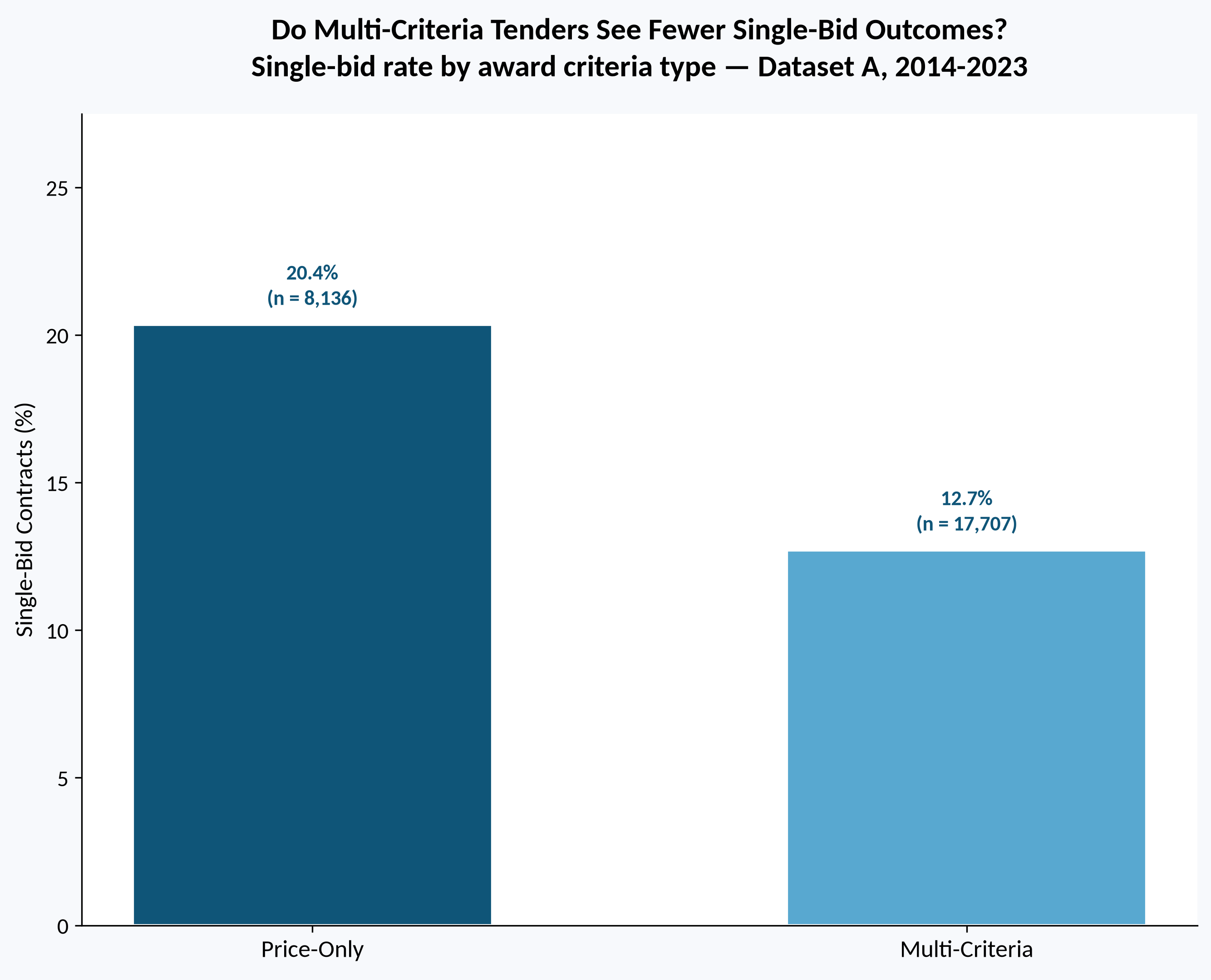
1. Price-only contracts are far more likely to result in a single bid. More than 20% of price-only contracts are limited to a single bidder, while it is closer to 13% in contracts that use multiple criteria to determine contract awards.
2. The percent of security tenders that attract just one bid is highly variable by country. In Ireland, for example, only 1.2% of security tenders attracted a single bid, while in Italy the figure is more than 30%.
.png)
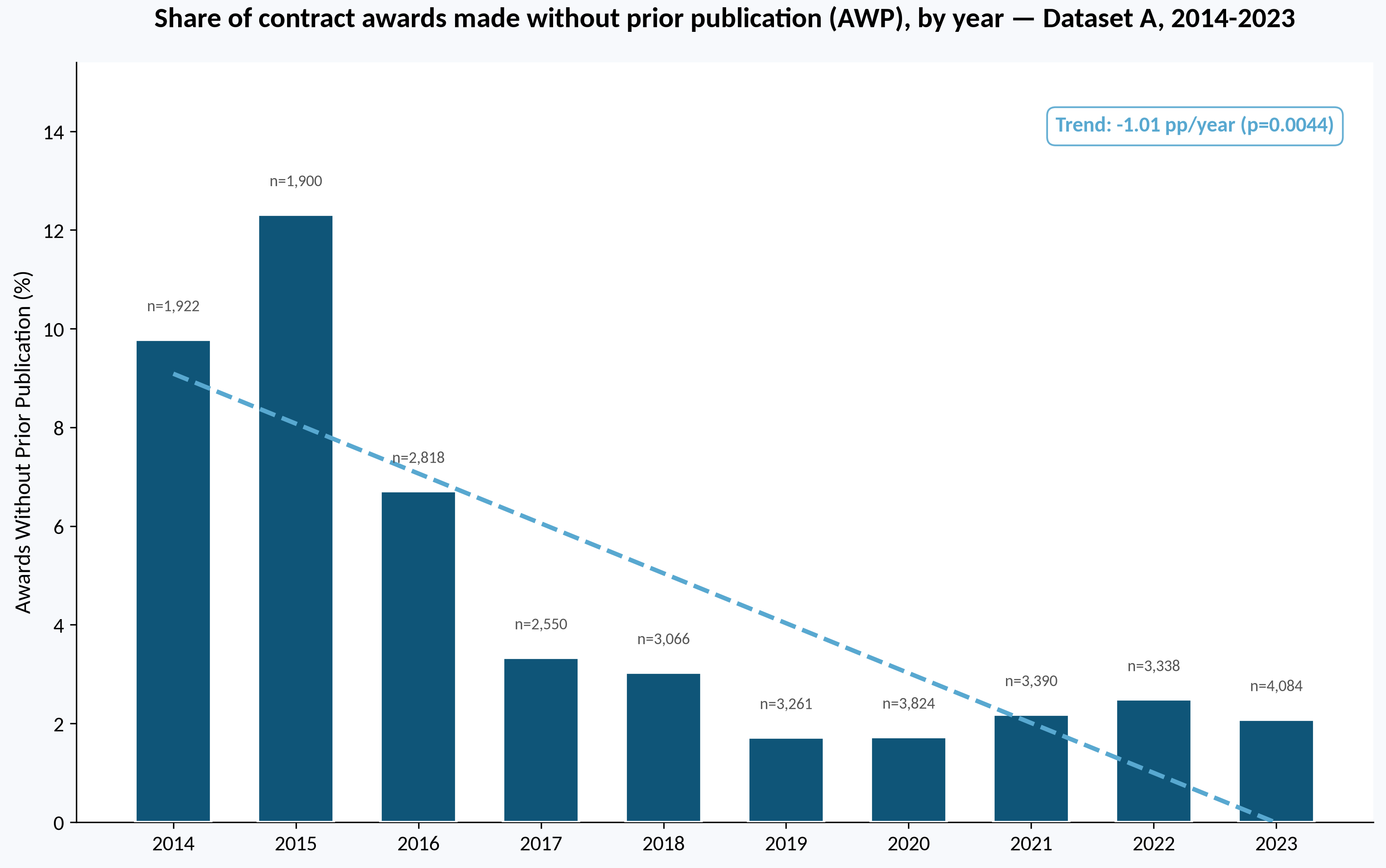
3. Awards without publication had been declining steadily but plateaued in 2019. Awarding contracts without prior publication removes the essential checks of open competition and transparency, increasing the likelihood that conflicts of interest or procurement irregularities go unnoticed.
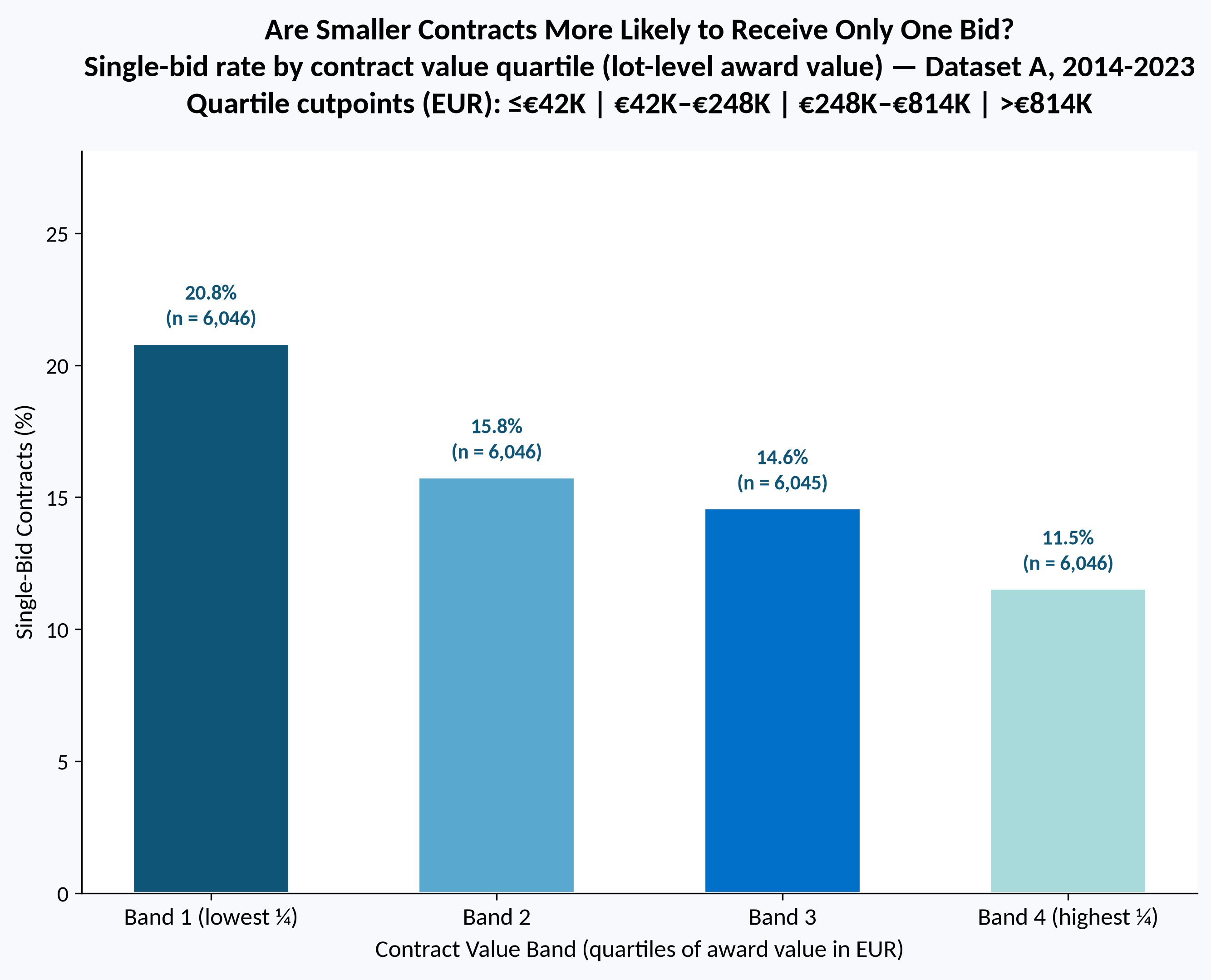
4. There is a decline in the percentage of tenders that attract a single bid as the value of the contract grows. This reflects a common procurement dynamic: larger contracts create stronger incentives for market participation, while lower value tenders frequently face participation barriers that result in single-bid outcomes.
Encouraging Participation
Data proves that governments can avoid risks from low participation by making non-price criteria part of the contract award. A focus group of industry professionals convened for the GSB Pulse offered other easy solutions:
- Ensure fair and realistic bid timelines. This allows bidders to prepare thoughtful, compliant proposals, improving competition and quality, focus group participants noted.
- Avoid disproportionate penalties or excessive transfer of risk to market participants. This both Inflates pricing and reduces competition by shifting excessive liability to providers, the group warned.
- Eliminate unilateral fine or penalty regimes, which allows the contracting authority to impose financial penalties entirely at its own discretion, without, for example, clear definitions of what constitutes a breach or an opportunity for the provider to remedy the issue. By creating unpredictable financial exposure, this practice sharply discourages participation.
- Monitor for excessive or irrelevant documentation requirements. This practice unnecessarily increases bid preparation costs and can also significantly deter participation, especially from SMEs.
Participation is key to a healthy procurement market, explains Hayman. “How we manage public procurement directly impacts the quality of services citizens receive. If governments go out, engages businesses, listens to their ideas on how to deliver more impact before a competition is finalized, then we see more trust and that leads to greater bids and more competition.”
Too often, Hayman suggests, government fail to consult with business associations, companies, and the experts that know an industry best. And, by not tapping deep domain knowledge, they miss the opportunity to build evidence-based reforms to procurement and secure better public services.
By not tapping deep domain knowledge, governments miss the opportunity to build evidence-based reforms to procurement and secure better public services.