





Security leaders are inundated with reports, surveys, after-action reviews, and emerging risk assessments. To help stakeholders focus on the developments most relevant to security operations, the Ligue has highlighted five recent findings from across the security landscape. Taken together, these studies point to several recurring themes: the importance of planning and coordination, the growing strategic role of security, the increasing influence of geopolitical and societal risks, and the need to prioritize quality when selecting and managing security providers. Whether examining event security failures, healthcare violence, enterprise security trends, or public procurement practices, each offers lessons for strengthening resilience and preparedness in 2027.
After-Action Review Highlights the Cost of Informal Security Planning
When political commentator Charlie Kirk was assassinated while speaking at an outdoor event at Utah Valley University (USA) in September 2025, the incident triggered a 100-plus-page independent review of what went wrong before, during, and after the attack. The audit paints a picture not of absent security measures, but of a high-profile event where key security decisions, risk assessments, and stakeholder coordination were not as formalized as the threat environment warranted.
The review noted numerous risk indicators were present, including a high-profile speaker, anticipated protests, private security personnel, elevated vantage points overlooking the venue, and significant public attention. Yet planners did not produce a documented Security Assessment or comprehensive Event Action Plan that addressed staffing requirements, command relationships, communications procedures, protective operations, contingency planning, and coordination with external partners. "The absence of a written Security Assessment and Event Action Plan limited UVU's ability to establish a coordinated security posture,” the report concluded. “It also limited the ability to document planning assumptions, identify resource gaps, assign responsibilities, and adjust the plan as attendance, protest activity, or other conditions changed.”
The absence of a written Security Assessment and Event Action Plan limited UVU's ability to establish a coordinated security posture.
Coordination was also lacking. Investigators found that "the absence of a formal pre-event briefing and coordinated walk-through" between university police and the speaker's private protection team represented a "critical missed opportunity." The review further noted that executive protection and law enforcement serve distinct but complementary functions and require close integration when protecting high-profile individuals.
Implications: The circumstances of the Kirk assassination were unusual to be sure, but the underlying lessons are universal, as organizations worldwide increasingly host events involving controversial speakers, public figures, and executive leaders within elevated threat environments. The report reinforces two enduring security principles: rigorous pre-event risk assessment is often as important as day-of security operations, and effective protection depends on early coordination between venue operators, security providers, emergency services, and law enforcement partners. (After-Action Report for Utah Valley University, An Independent Review of the Events Surrounding September 10, 2025, and Recommendations for Future Event Safety and Security, Sept. 25, 2026.)
Contract Security Has Become the Industry's Operating Model
A new global survey of enterprise security leaders suggests that the modern security function bears little resemblance to the traditional protection model. Today's security departments are increasingly responsible for a wide range of functions, including: workplace violence prevention and threat management (73% own or manage the function); emergency response and planning (61%); event security (76%); business resilience (55%); and liaison with public-sector law enforcement (70%). Even social media threat monitoring (43%) and keeping track of the weather (53%) are on security’s plate these days.
The report also reveals just how central contract security has become to organizational protection. Only 5% of surveyed organizations reported relying exclusively on proprietary security officers. By contrast, 43% operate entirely with contract security personnel, while another 52% use a blended model combining proprietary and contract officers. In other words, 95% of surveyed security organizations now depend on contract security in some capacity.
Far from being a standalone guarding function, contract security appears to have become an integral part of how organizations manage risk across facilities, events, operations, and business continuity efforts. The report notes that security leaders are increasingly expected to align security with broader business objectives while simultaneously managing a growing range of operational responsibilities.
Implications: As security programs take on broader mandates and more complex risk portfolios, the relationship between client organizations and their security providers becomes increasingly consequential. The findings suggest that selecting the right contract security partner, establishing clear expectations, and maintaining strong operational coordination are no longer tactical considerations and have become, for most organizations, strategic requirements. (The 2026 Security Benchmark Report, Security Magazine, October 2026.)

Healthcare Security Teams Confront Rising Violence Amid Calls for Greater Investment
Hospitals are challenging security environments. Security personnel must safeguard staff, patients, visitors, and critical infrastructure while operating in open-access facilities where emotions often run high and incidents can escalate quickly. Despite its criticality, however, new research from Perpetuity Research & Consultancy International suggests many healthcare security teams are being asked to shoulder growing responsibilities without receiving the attention, resources, or organizational support they need.
The report paints a troubling picture of the operational environment facing healthcare security. Among respondents, 81% reported that violence, aggression, or abuse by patients against staff occurs daily, while half indicated their organizations do not have enough security personnel to meet operational demands. Researchers also found that only 42% believed senior management proactively supports security, and just 40% reported having a board-endorsed security strategy in place.
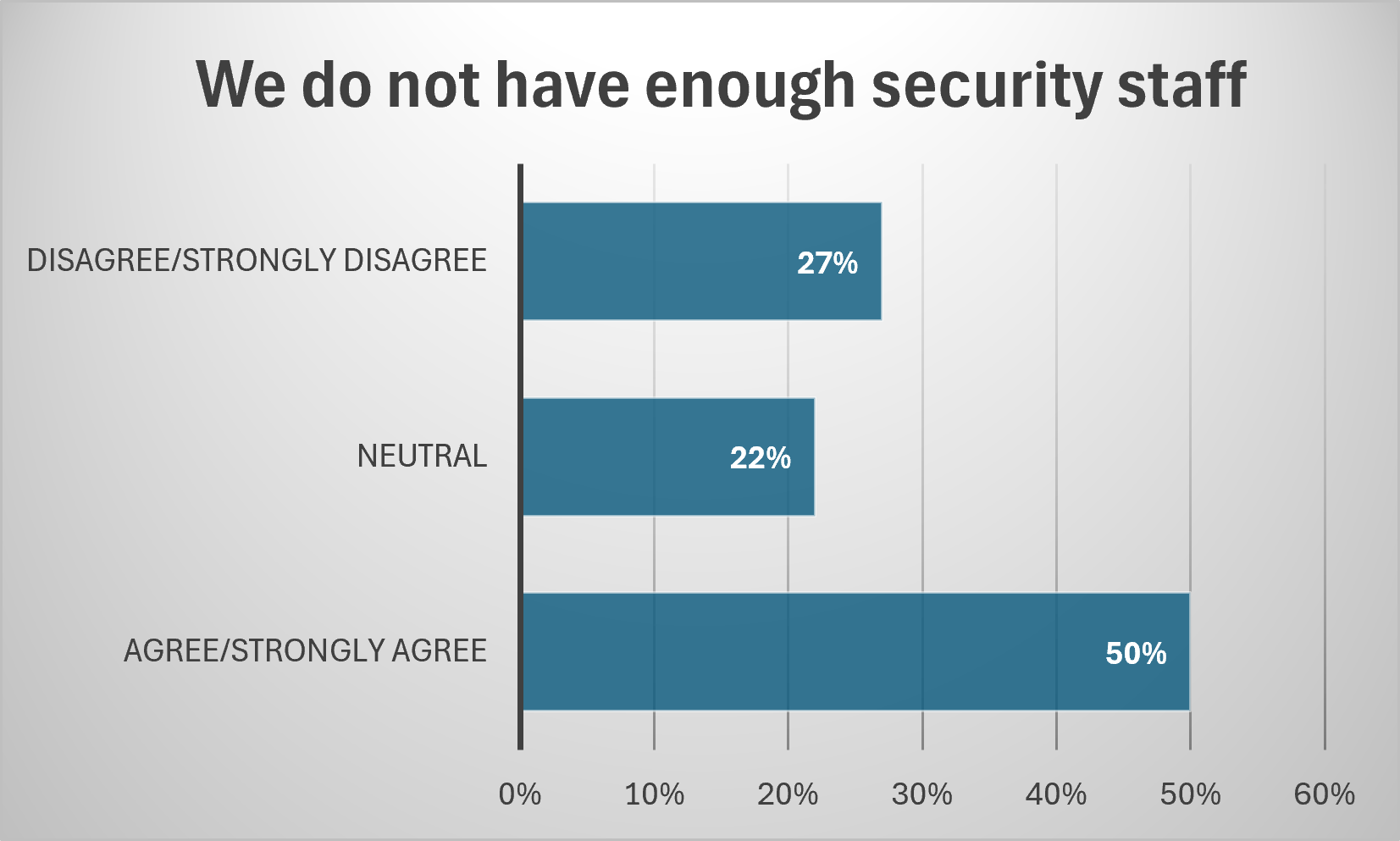
Healthcare security professionals responding to the study repeatedly emphasized that security remains undervalued despite the risks they manage. Properly resourcing security is often a problem, with respondents citing “a general need for greater investment in security to better reflect its importance, to improve safety, to be able to tackle key issues such as violence and aggression, and to be prepared for upcoming issues.” Half said they simply need more security staff to manage the risk environment.
Implications: While the study focuses on the UK healthcare sector, the underlying challenge is not unique. Security is often viewed as a support function until a crisis occurs, but the findings suggest that organizations facing persistent violence, workplace aggression, and complex public-facing risks may need to treat security as a strategic capability rather than a discretionary expense. “The striking finding from this research is not simply that healthcare security faces serious challenges, but that its role and contribution are too often misunderstood. When it works well it does much more than react to incidents: it helps create the safe environment in which staff can work and patient care can be delivered,” said Professor Martin Gill, who led the research at Perpetuity Research. Investing in trained personnel, effective governance, and stronger security programs may not only improve safety outcomes, but also help protect staff, support operations, and enable the delivery of core services. (The Role of Healthcare Security: Addressing Key Challenges, Perpetuity Research & Consultancy International, 2026.)
Geopolitical Turbulence Pushes Security Further Into the Boardroom
Wars, trade disputes, cyber conflict, political instability, and supply chain disruptions aren’t distant concerns discussed only by governments and diplomats. A new survey of Chief Security Officers (CSOs) at large multinational companies finds geopolitical risk has emerged as one of the most significant issues facing organizations worldwide, prompting many security leaders to rethink how they prepare for an increasingly uncertain operating environment.
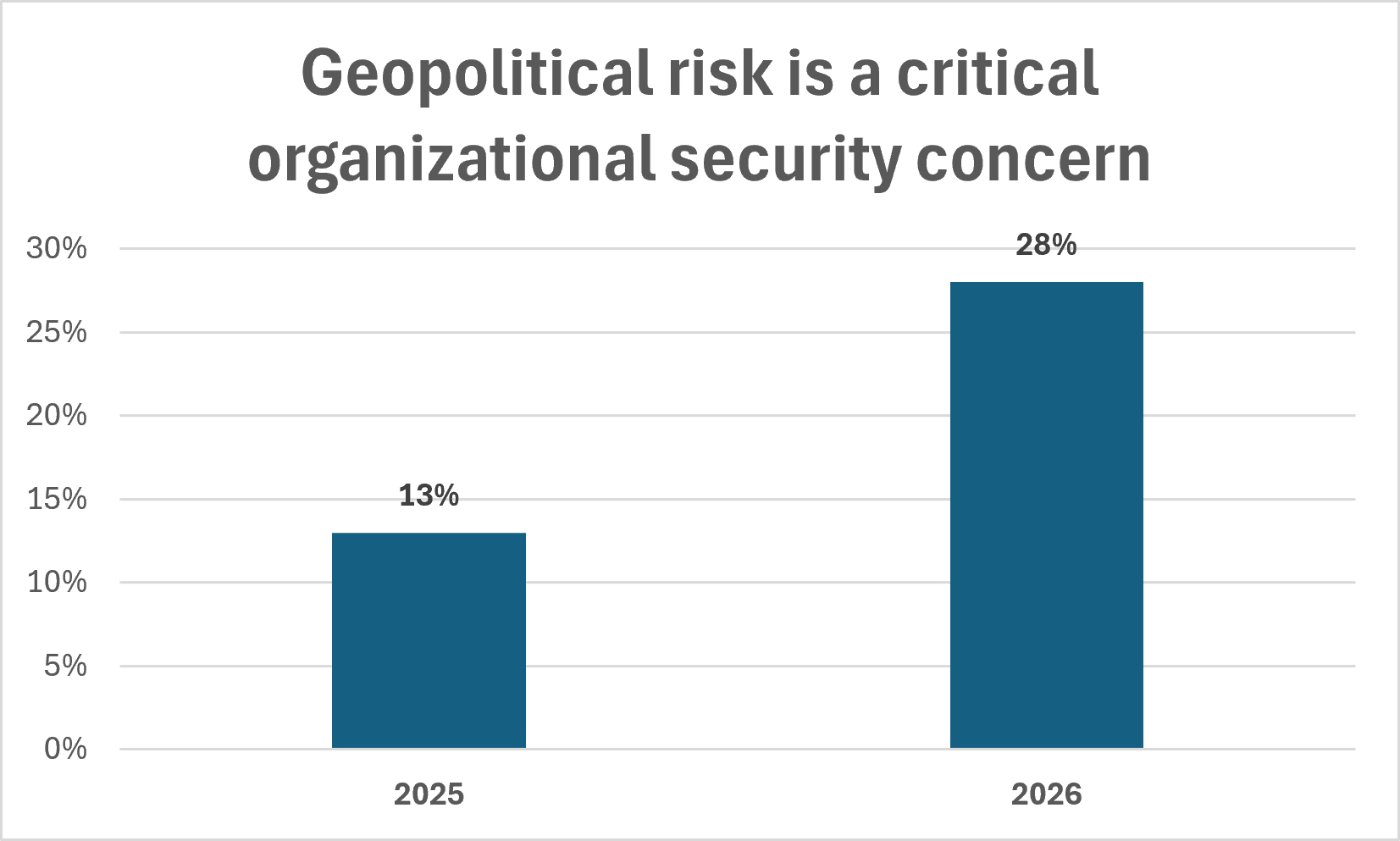
The survey found that 74% of CSOs now rank geopolitical risk as either "critical" or "high," with concern over ongoing conflicts nearly doubling over the previous year. Respondents also reported growing concern over travel risks and the broader business impacts of geopolitical instability. One security leader noted the need for organizations to re-assess their scenario planning: "We have gone back to our scenarios to stress test them. We need to confirm that we have thought about the most realistic worst-case scenario and pushed the boundaries a little more than before."
The research suggests that security teams are being relied upon to play an expanding role in helping their organizations understand and prepare for these risks. Intelligence gathering, crisis management, incident response, scenario planning, and trusted relationships with government and regional partners were identified as some of the most valuable contributions security functions can make when geopolitical events begin to affect business operations.
Implications: For many organizations, geopolitical developments are no longer abstract risks. Whether the issue is armed conflict, economic uncertainty, travel disruption, cyber activity by state actors, or civil unrest, global events are increasingly shaping day-to-day business decisions. The findings reinforce the growing importance of intelligence-led security programs that can help organizations anticipate disruptions, assess risk, and strengthen resilience before events escalate into crises. (Annual Chief Security Officer Survey 2026, The Clarity Factory, 2026.)
New European Study Reinforces Concerns About Lowest-Price Security Procurement
Earlier this year, the Ligue's GSB Pulse: Public Procurement of Security Services in Europe found that public authorities continue to place overwhelming emphasis on price when purchasing security services, with a median weighting of 85% across tens of thousands of public tenders. A newly released study commissioned by the European Labour Authority arrives at a similar conclusion, warning that procurement practices can have a profound impact on security quality, workforce standards, and market behaviour throughout the private security sector.
The report examined undeclared work and labour compliance across Europe's private security industry and found that while serious labour violations appear relatively uncommon overall, procurement decisions can either strengthen or undermine quality standards. Researchers identified a persistent reliance on lowest-price tendering as a key concern, noting that the associated pressures can ripple throughout supply chains and subcontracting arrangements. As the report states, "the risks associated with choosing the lowest price include compromised contract performance, unfair competition, breaches of labour law, non-compliance with sector-specific legislation, and, more broadly, a race to the bottom."
The risks associated with choosing the lowest price include compromised contract performance, unfair competition, breaches of labour law, non-compliance with sector-specific legislation, and, more broadly, a race to the bottom.
Importantly, the study does not portray these challenges as inherent to the private security sector itself. In fact, researchers found that licensing requirements, regulatory oversight, training obligations, and compliance controls help keep overall levels of undeclared work relatively low across much of Europe. Instead, the report points to procurement design, contract management, and quality assurance as critical factors influencing outcomes.
Implications: Security services protect people, public spaces, and critical infrastructure. The findings reinforce a growing recognition that procurement decisions are ultimately security decisions. While price will always remain an important consideration, both the Ligue's procurement research and this latest European study suggest that overreliance on cost-based award criteria may create unintended consequences. For purchasers, the challenge is not simply buying security services at the lowest price, but selecting capable, compliant, and professional providers that can deliver the quality and resilience increasingly demanded by today's risk environment. (Report on Undeclared Work and Bogus Self-Employment in the Private Security Services Sector, European Labour Authority, 2026; and GSB Pulse: Public Procurement of Security Services in Europe, International Security Ligue, 2026.)