




Key Points
- Police response times for non‑emergency incidents—such as business burglaries, vandalism, and trespassing—have risen sharply in every major U.S. city that publishes data.
- As public agencies prioritize emergencies, businesses increasingly shoulder longer periods of self‑management during security incidents.
- Modern security strategies must account for extended response windows and strengthen on‑site or private‑sector capabilities to reduce loss and maintain resilience.
Across much of the world, police agencies are confronting the difficult reality of rising demand, shrinking resources, and widening gaps between public expectations and what law enforcement can realistically deliver. While attention is often focused on emergency response times, where data shows mixed results, there is a more substantial shift occurring in the background. Police response to non emergency incidents is steadily slowing, including for the types of property crimes that directly affect businesses every day.
For global companies, this trend is a strategic security issue. And the data emerging from the United States—one of the few countries that publishes detailed, multi year response time metrics—offers a clear warning for organizations everywhere.
Low Priority Call Response Is Slowing Dramatically
So-called “Priority 3” calls — non-emergency incidents such as business burglaries discovered after the fact, vandalism, trespassing, suspicious activity no longer in progress, and theft reports — represent the majority of calls that private businesses rely on police to handle. Not life threatening emergencies, sure, but they’re the incidents that shape a company’s risk profile, influence loss exposure, and affect employees’ sense of safety. These are the calls that determine how long a company must manage an incident on its own before public police arrive—if they arrive at all.
Not life-threatening emergencies, sure, but they’re the incidents that shape a company’s risk profile, influence loss exposure, and affect employees’ sense of safety.
And they are increasingly subject to long delays.
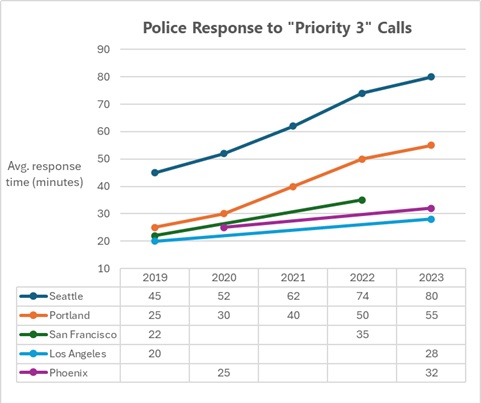
- Seattle has seen a 35-minute increase in Priority 3 response times rose between 2019 to 2023 (Seattle Police Department Calls for Service Dashboard).
- Portland has had Priority 3 response times more than double from 25 minutes in 2019 to 55 minutes in 2023 (Portland Police Bureau Open Data).
- San Francisco’s non emergency “Priority C” calls increased from 22 minutes (2018) to 35 minutes (2022)(SFPD Published Reports).
- Los Angeles (for Code 2 non emergency but urgent calls) and Phoenix (for Priority 3 calls) have also seen response times climb in recent years.
Seemingly a Global Challenge
It’s extremely rare for jurisdictions around the world to publish multi year Priority 3 response time data, so it’s hard to say, exactly, how typical these US cities are, but since the challenges facing police departments are global, it’s easy to think they are examples of a systemic trend than isolated anomalies.
Despite the dearth of response time metrics, the broader trend is visible outside the United States.
- In England, emergency response times have lengthened significantly, and police forces have openly deprioritized lower urgency calls.
- In Australia, major police services report rising response times and increasing reliance on phone based reporting for non urgent incidents.
- In Canada, several major cities have shifted non emergency calls to online reporting systems.
- In New Zealand, police have consolidated response districts, increasing travel distances for officers.
Ultimately, increasing police focus on emergencies and slower police response times (or non-response) requires businesses to shoulder more responsibility for managing non-emergency security incidents. The reasons why are pretty universal. Law enforcement leaders around the world describe a similar set of pressures:
- Staffing shortages and difficulty recruiting new officers;
- rising call volumes, especially mental health related incidents;
- budget constraints and competing municipal priorities;
- geographic expansion of service areas; and
- policy shifts that prioritize violent crime and emergencies.
Public expectations have not waned, however. And the consequence for societies is a widening gap between what police agencies are expected to do and what they can realistically deliver.
Business Implications
Priority 3 calls for non emergency incidents matter deeply to businesses and hold important ramifications.
- When police response times stretch from minutes to hours, the consequences of an incident become a larger part of the risk equation.
- Companies can no longer rely on public police to provide the same baseline level of support they’ve traditionally enjoyed, meaning the “public safety buffer” is shrinking.
- Private security is increasingly required to be the first responder for non emergency incidents: Businesses are hiring private patrols to respond to alarms; shopping districts are contracting private security to manage disorder; and residential communities are pooling resources to fund private patrols.
Understanding public police response is foundational to security strategy. In countries and regions experiencing cuts in community policing, private businesses must adjust their investment in security to align with the decline in support from public police. This may mean adjusting on-site security levels considering the types of calls to which police will and will not respond and for how long a company is expected to manage on its own before help arrives from public safety agencies. Companies may find themselves needing to fill in security gaps to provide workers with the sense of safety and security that public safety and law enforcement have traditionally provided.
In countries and regions experiencing cuts in community policing, private businesses must adjust their investment in security to align with the decline in support from public police.
In light of trends in law enforcement response, businesses should identify what types of incidents police will and will not respond to and conduct a Response Time Analysis to understand:
- how long police take to respond to different types of incidents;
- how long the business must manage an incident independently;
- and what resources are needed to bridge that gap.
Specifically, businesses may need to question if their current security posture adequately covers the window between incident and police response. The need to strengthen incident response capabilities may be a call to enhance use of on site or mobile security patrols; remote monitoring centers; alarm verification teams; private first response units; and enhanced training for security officers
And despite slowing response times, local police remain essential business partners. Companies should engage proactively with them, such as by coordinating on camera placement and information sharing or participating in business police liaison programs.
It may also be necessary, as one security director told us, to “strong arm” local police to pay more attention to crime in a particular area. He said his team went to great investigative lengths to document crime occurring in and around properties in an effort to compel law enforcement to pay closer attention and intervene more quickly. While not all firms may not need to go to such lengths, at a minimum, “companies need to understand how, who, when, why, and where crime is going on around you, share that information with police, and identify how you want them to assist you in protecting your facilities.”
New Reality, New Opportunity
The slowing of Priority 3 police response is probably not a temporary disruption, and more likely a structural shift. It is also an opportunity for organizations to modernize their security strategies, strengthen resilience, and reduce losses.
Public police will always be essential. But as their resources are stretched, private security is increasingly becoming the stabilizing force that keeps businesses safe, operations running, and communities confident.